13 August 2026 – Night of the Stars 2026
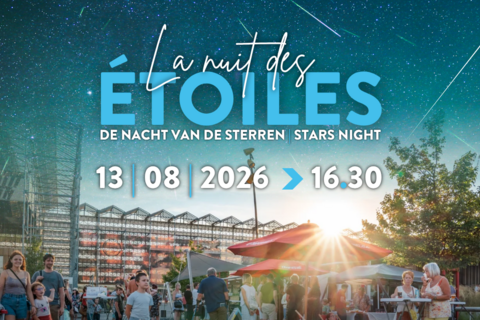
13 August 2026 – Night of the Stars 2026
From toFREE EVENT – NO BOOKING REQUIRED
The Night of the Stars returns to the Euro Space CenterNight of the Stars 2026: a cosmic evening at the Euro Space Center
The Euro Space Center invites you to a brand-new edition of the Night of the Stars. Join us in August, at the peak of the Perseid meteor shower—one of the most spectacular astronomical events of the year, with up to 100 meteors per hour streaking across the summer sky.
What's new in 2026
Talks"Journey to the Heart of Unknown Worlds" – Vincent Jacques
Discover the fascinating world of meteorites. At first, they may look like nothing more than ordinary rocks… By the end of this talk, you'll see the worlds they came from. Vincent Jacques takes you on a journey through these remarkable "rocks from space", from meteorites that have fallen close to home to some of the rarest specimens ever found, preserved since the earliest moments of our Solar System. A fascinating exploration of the origins of our Universe.
"Planet Mars" – Yannick Willame
When the first spacecraft flew past Mars in the 1960s, they revealed a barren, crater-covered landscape, giving the impression of a cold and lifeless world with little to offer. Later missions, however, uncovered a spectacular planet shaped by enormous volcanoes, vast canyons, ancient riverbeds and glaciers. Since then, satellites, landers and rovers have continued to explore the Red Planet using increasingly sophisticated instruments. One of them is NOMAD, an instrument developed by the Royal Belgian Institute for Space Aeronomy, which has been orbiting Mars aboard the ExoMars Trace Gas Orbiter since 2016 to study its atmosphere. Together, NOMAD and other missions reveal a surprisingly dynamic world, where the atmosphere, weather and climate are driven by dust, powerful dust storms, clouds and seasonal cycles.
"Nobody Understands Quantum Mechanics? But Why?" – Yves Caudano
For more than a century, quantum mechanics has achieved remarkable scientific success while remaining extremely difficult to interpret. This paradox led the renowned physicist Richard Feynman to famously state: "I think I can safely say that nobody understands quantum mechanics." Through a selection of fascinating quantum phenomena, this talk explores the meaning behind that famous quote. Why does quantum mechanics challenge our everyday intuition, even though physicists have mastered its mathematical framework and use it to make extraordinarily accurate predictions?
Evening programme
- Solar observation – Safely observe the Sun's surface through specially equipped solar telescopes.
- Spectroscope Workshop (ages 6+) – Discover the signatures of light.
- Star Map Workshop (ages 8+) – Build your own rotating star chart.
- 3D Constellation Workshop (ages 4+) – Create a glowing constellation to take home.
- Sundial Workshop (ages 6+) – Learn to tell the time using shadows.
- Mars Base Workshop (ages 6+) – Imagine what life on the Red Planet could be like.
- Sun in Your Hand Workshop (ages 6+) – Paint your own Sun and make it shine like a real star!
- FM Radio Receiver Workshop (ages 9+) – Build your own radio receiver.
- Pulsar Hunt (ages 6+) – Search for the five neutron stars hidden throughout the site!
Throughout the evening
(Schedules will be announced on site.)
- Live Planetarium Shows – Explore constellations, planets and nebulae with expert commentary.
- Myths & Constellations Storytelling – by Iota Gaganas (ages 4+).
Astronomical highlights not to be missed
- The Perseids :The Perseid meteor shower is active throughout the evening and during the first part of the night, reaching its peak around 12 August. Tiny particles left behind by Comet Swift-Tuttle enter Earth's atmosphere at speeds exceeding 50 km/s, creating long, bright streaks of light—sometimes even spectacular fireballs.
- The Milky Way :Throughout the night, the Milky Way appears as a luminous band stretching from east to west across the sky, providing ideal conditions for spotting nebulae and star clusters.
- The Summer Triangle :The famous Summer Triangle, formed by Vega (Lyra), Deneb (Cygnus) and Altair (Aquila), dominates the night sky as darkness falls, making it an excellent guide for finding your way around the heavens.
- Saturn: from midnight onwards, the ringed planet will rise above the eastern horizon. Observe it through the Cosmic Valley telescopes and marvel at its spectacular rings.
This year: exceptionally favourable observing conditions
The Night of the Stars 2026 will benefit from outstanding observing conditions. The Moon will be in its New Moon phase, making it virtually invisible in the night sky. Without moonlight, the conditions will be ideal for observing the Perseid meteor shower, the Milky Way, star clusters, nebulae and galaxies.
Entertainment & activities
- Astronomy clubs – Guided observations and inspiring discussions with passionate amateur astronomers.
- Face painting – Space-themed face painting for all ages.
- Balloon artist – Take home an original balloon creation inspired by space.
- Live music on Sun Square – A festive atmosphere guaranteed.
- And much more...
Food & drinks
The Voyager Café remains open throughout the evening, serving hot drinks, snacks and sweet treats—perfect for recharging between moments of wonder beneath the stars.
Ready to look up?
Join us and experience an unforgettable Night of the Stars 2026 at the Euro Space Center!