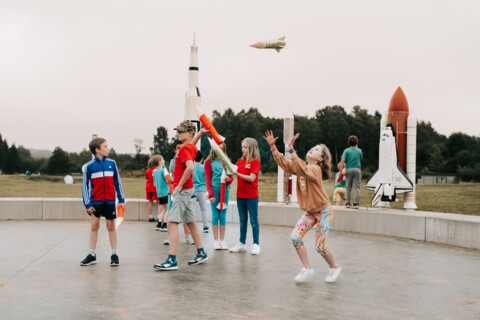
Why choose an educational camp during the school holidays?
Choosing an educational camp during the school holidays gives your child a different way to learn, away from the traditional classroom and everyday screens. Here, learning happens through experience: children build, test, experiment and discover for themselves. This hands-on approach not only enhances learning but also encourages motivation and engagement.
Throughout the activities, children develop practical skills that will benefit them long after the camp has ended, including critical thinking, problem-solving, teamwork and curiosity. In a world where science and technology are becoming increasingly important, these educational camps offer a valuable first introduction to fields such as astronomy, robotics and space exploration.
Which children's camps are available in Wallonia during the school holidays?
Wallonia offers a wide range of educational and original holiday camps for children of all ages. Located in Transinne, in the Belgian province of Luxembourg, the Euro Space Center is the region's leading destination. It offers a complete range of camps designed as immersive adventures, where every subject is explored through hands-on experience rather than textbooks.
Space and astronomy camps
This is undoubtedly the flagship theme among educational holiday camps in Wallonia.
Children and teenagers discover the planets, space missions, the challenges of lunar exploration and the mysteries of the Universe. These camps combine sky observation, the use of scientific instruments, mission simulations and astronaut-inspired training.
Some camps focus primarily on astronomy, teaching participants how to identify constellations, understand the lunar cycle and observe the stars beneath the clear skies of the Ardennes. Others immerse children in the daily life of astronauts through mission preparation, teamwork and the discovery of space technologies.
The Astronaut Camp, available from the age of 9 and offered in a Junior version from the age of 6, allows children to spend a week following in the footsteps of space pioneers. The Astronomy Camp provides an immersive introduction to observing and understanding the Universe.
For families wishing to combine science with language learning, the Astronaut Camp is also available in English and Dutch. Finally, the Satellites Camp takes the experience even further: participants build and launch their own satellite before transmitting data by radio, just like real space engineers.
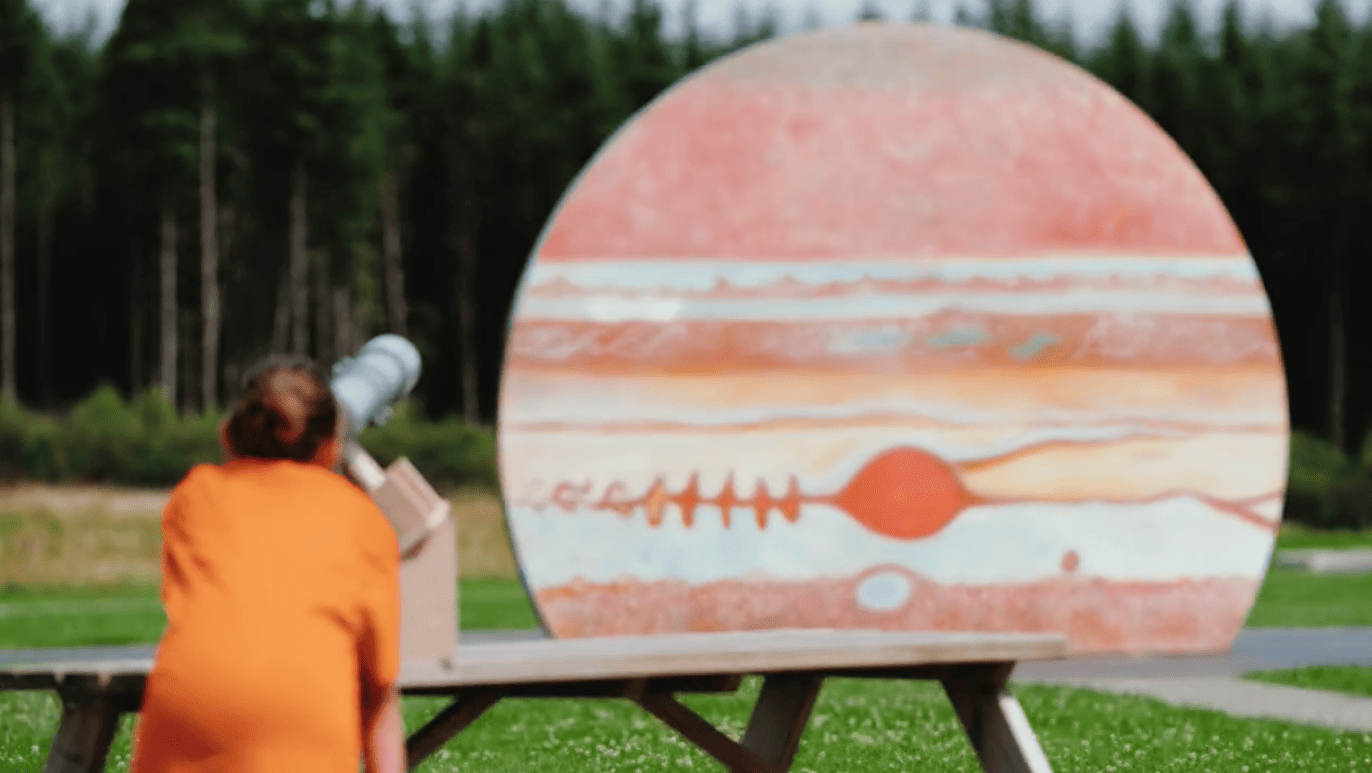
Technology and innovation camps
Robotics, drones, telecommunications and 3D modelling: these educational and original camps introduce young people to technologies and tools used across many industries, far beyond the space sector.
The Robotics Camp challenges participants to build and program an autonomous robot capable of navigating complex environments, similar to the future lunar and Martian bases imagined by space agencies.
The Drone Camp offers a highly practical experience combining drone assembly, piloting and aerial photography. At the end of the week, every participant takes home their own drone.
The 3D Modelling Camp introduces children to computer-aided design (CAD) and 3D printing. A Level 2 programme is also available for participants wishing to further develop their skills.
Finally, the Telecommunications Camp stands out thanks to its certification pathway. Participants prepare for the official BIPT examination to obtain an amateur radio licence—an uncommon opportunity for a holiday camp.
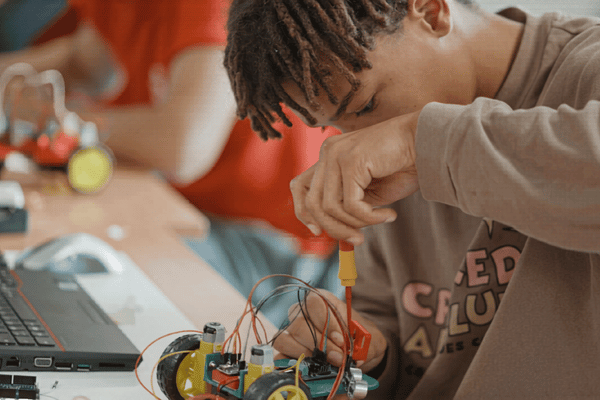
Specialised camps and unique experiences
Some programmes go even further, offering a truly immersive experience through activities that are rarely available to the general public.
The Rocket Camp allows participants to design, build and launch their own rocket, from the engine to the fins. The highlight of the week is the final group launch, watched by parents.
The Meteorite Camp turns children into genuine space explorers. Participants analyse meteorite samples, build their own collection device and discover what these fragments reveal about the formation of our Solar System.
The Gliding Camp combines astronaut-inspired training with glider flights at the Saint-Hubert Gliding Centre. It is a unique experience bringing together the thrill of flight, aviation discovery and spectacular views over the Belgian Ardennes.
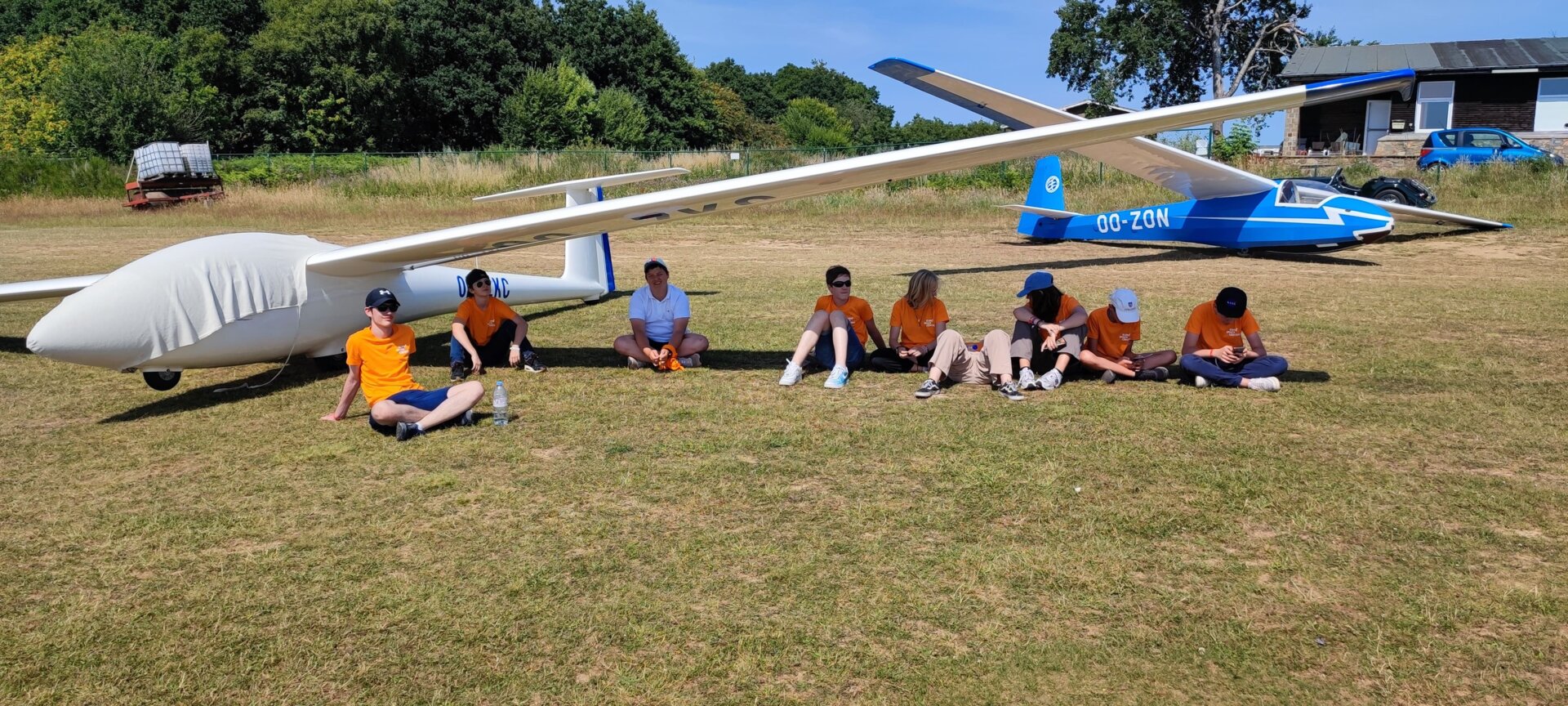
A unique immersive experience at the Euro Space Center
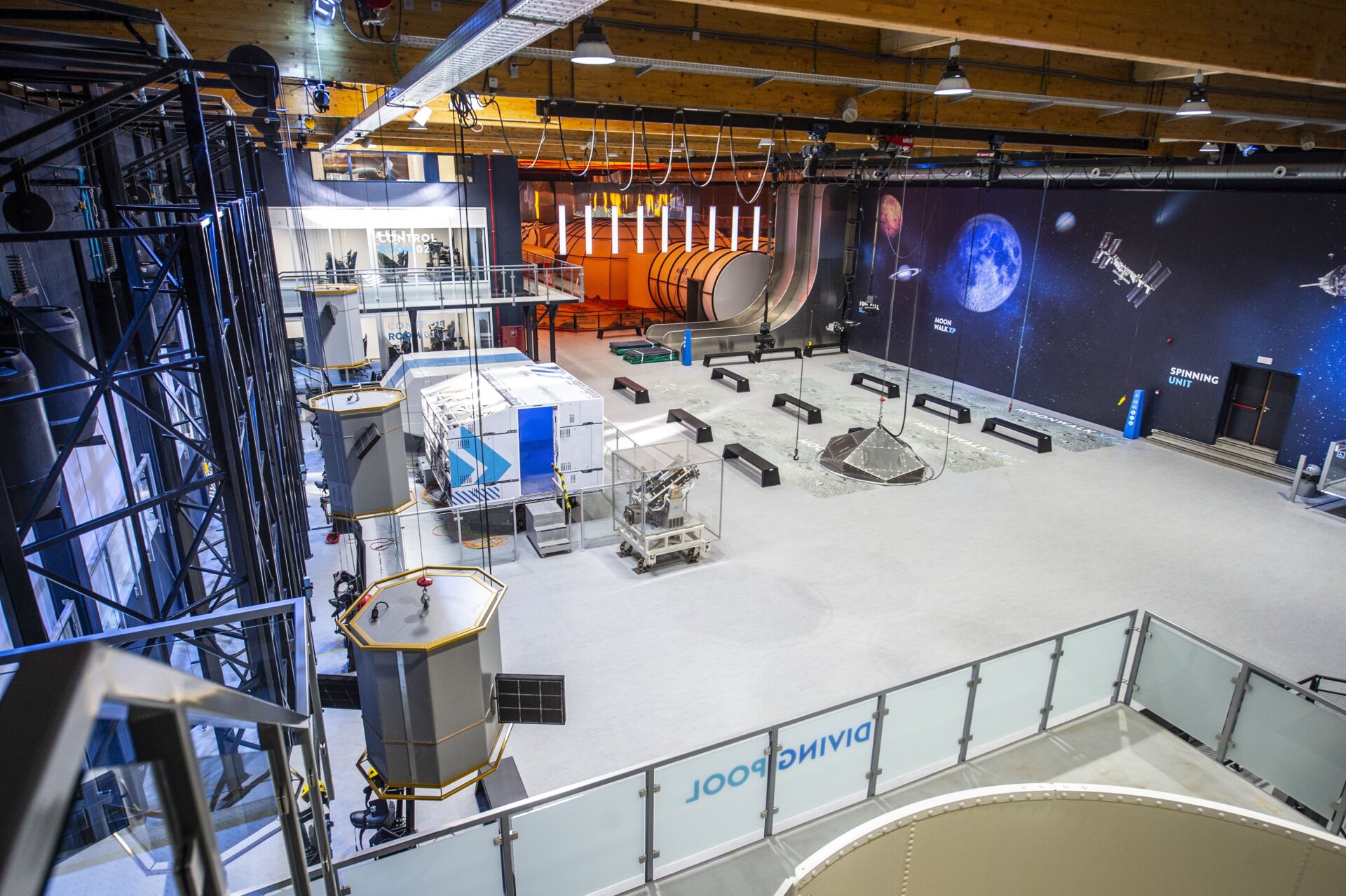
For more than 35 years, the Euro Space Center has been dedicated to making science and space exploration accessible to everyone. Located in Belgium, the centre welcomes thousands of visitors every year to enjoy a unique space-themed experience.
During a one-day visit, participants explore the world of space through more than 11 immersive and interactive activities, allowing them to complete a genuine space mission. Simulators, physical challenges and immersive experiences create a hands-on approach focused on discovery, experimentation and excitement.
The centre also welcomes numerous school groups, offering tailor-made day trips and residential programmes. Whether taking part in the Space Classes programme or a one-day excursion, pupils enjoy a complete change of scenery that combines learning with immersion. It is a giant leap for their knowledge, providing a practical way to discover new subjects and imagine themselves as part of the world of space exploration.
Building on this experience, the Euro Space Center's holiday camps take immersion even further. For one week, participants follow in the footsteps of the pioneers of space. Astronautics, astronomy, rocket building, robotics or satellites: everyone chooses their own speciality and takes on challenges inspired by real space missions. A fully immersive adventure where space exploration becomes something to experience first-hand.
What age can children take part?
The Euro Space Center holiday camps welcome children and teenagers aged 6 to 18. From the age of 6, the Junior programmes (Junior Astronaut and Junior Astronomy) provide a first space adventure designed specifically for younger children.
When are the camps held?
The camps are organised throughout the year, with the widest choice available during the summer holidays.
Summer holidays
Summer camps run from July to August, offering a wide range of themes and levels.
School holidays (Autumn, Christmas, Carnival and Easter)
Additional camps are organised during the different school holidays, with programmes adapted to each season. During the Autumn holidays, for example, participants can choose from the Astronaut Camp, Junior Astronaut Camp and 3D Modelling Camp. These two-week sessions provide an excellent opportunity to discover the world of space in an immersive environment, even outside the summer season.
What does a typical camp week look like?
Daily programme
The camps run from Monday to Friday and include more than 35 hours of activities.
Each day is carefully structured, balancing exciting activities with appropriate breaks.
Day camp participants
- Arrival from 9:00 a.m.
- Activities end at 5:30 p.m.
Residential camp participants
The adventure begins on Sunday evening. Participants may arrive from 5:00 p.m. to settle into their rooms before the welcome briefing. The first communal dinner is served at 6:30 p.m.
From Monday to Thursday, the daily schedule is as follows:
- 7:30 a.m. – Wake-up
- 8:00 a.m. – Breakfast
- 9:00 a.m. – Start of space activities
- 12:00 p.m. – Lunch
- 1:00 p.m. to 5:30 p.m. – Afternoon activities, including a 30-minute break at 4:00 p.m.
In the evening, participants enjoy some free time before dinner at 6:30 p.m., followed by an organised evening programme.
On Friday, the morning follows the same schedule. At 3:00 p.m., participants present their week's achievements to their parents before taking part in a final activity linked to their chosen camp, such as a rocket launch, a robot demonstration or a 3D project presentation.
The week concludes with a graduation ceremony before departure at 4:30 p.m.
Supervision and safety
Every camp is supervised by a dedicated team of professional Space Instructors, trained in their respective disciplines and experienced in working with young people.
For residential participants, an overnight supervisor is present every night to ensure everyone's comfort, safety and well-being.
Accommodation and catering
The Euro Space Center accommodation is spread across three themed floors: Earth, Mars and Sky. The centre has 24 bedrooms, each accommodating up to ten participants, with separate accommodation for boys and girls.
Meals are prepared on site by the Voyager Café, which caters for a wide range of dietary requirements, including vegetarian, pork-free, gluten-free, lactose-free and Indian cuisine, ensuring that every participant can enjoy their meals with complete peace of mind.
Practical information and registration
How to register
Registration is quick and easy through our website or by contacting the Euro Space Center team directly.
Telephone: +32 (0)61 65 64 65
Email: camps@eurospacecenter.be
Early booking is recommended, as some sessions fill up very quickly.
Location and access
The Euro Space Center is located in Transinne, in the municipality of Libin, Belgian Luxembourg, alongside the E411 motorway, which connects Brussels with the Grand Duchy of Luxembourg. Free parking is available on site.
- From Brussels: approximately 1 hour 30 minutes via the E411.
- From Namur: approximately 45 minutes.
- From Liège: approximately 1 hour 15 minutes via the E25 and E411.
- From Luxembourg City: approximately 1 hour 15 minutes via the A6/E25.
- From Northern France (Lille, Reims): between 2 and 2½ hours, depending on your departure point.
Families travelling without a car can reach the Euro Space Center by bus from the railway stations of Libramont and Jemelle, both of which are served by direct train connections from Brussels and Liège.
How do you choose the right camp for your child?
With around ten different camps available, choosing the right one may seem challenging.
Here are the four main criteria to consider:
Age is the first and most obvious criterion. The Junior camps are designed for children aged 6 to 9, while the other camps welcome participants from 9, 10, 11, 12 or 13 years old, depending on the programme. Always check the recommended age before registering.
Next, consider your child's interests. Children fascinated by the stars will thrive in the Astronomy Camp. Teenagers interested in technology may prefer Robotics, 3D Modelling or Telecommunications. Children who enjoy building and experimenting will love the Rocket Camp, while those who simply want to experience everything will find the Astronaut Camp to be the perfect choice.
The format also deserves consideration. Every camp lasts one week, but the residential option offers a completely different experience from the day camp. For a first participation, some families prefer to start with the day camp before choosing the residential option the following year.
Finally, prior knowledge is not required. However, some subjects such as Satellites, Telecommunications and Robotics are naturally more technical and therefore better suited to teenagers aged 13 and over. The 3D Modelling Camp also offers a Level 2 programme for participants wishing to build on previously acquired skills.
If you are unsure, the Euro Space Center team will be happy to help you choose the programme that best matches your child's interests and profile. The best camp is, above all, the one that matches your child's curiosity and enthusiasm.
After the camp: continue your space adventure
The camp may be over, but the adventure doesn't have to end there. The Euro Space Center offers several ways to extend the experience, whether with family, friends or as a first introduction before enrolling in a holiday camp.
A one-day visit allows the whole family to discover the centre or relive the excitement of camp while training like an astronaut—without committing to a full week.
MiniTrip packages: two days of space adventure for the whole family
Looking for something more immersive than a day visit without signing up for a full week's camp? The MiniTrip packages were designed for exactly that.
Over two days, families and friends immerse themselves in the world of the Euro Space Center, enjoying accommodation, full board and exclusive activities, some of which are normally reserved for camp participants.
Mission Orion – a family space getaway
Enjoy unlimited access to both the indoor and outdoor parks for two days while earning your first astronaut stripes.
The package includes:
- one night in a space-themed room;
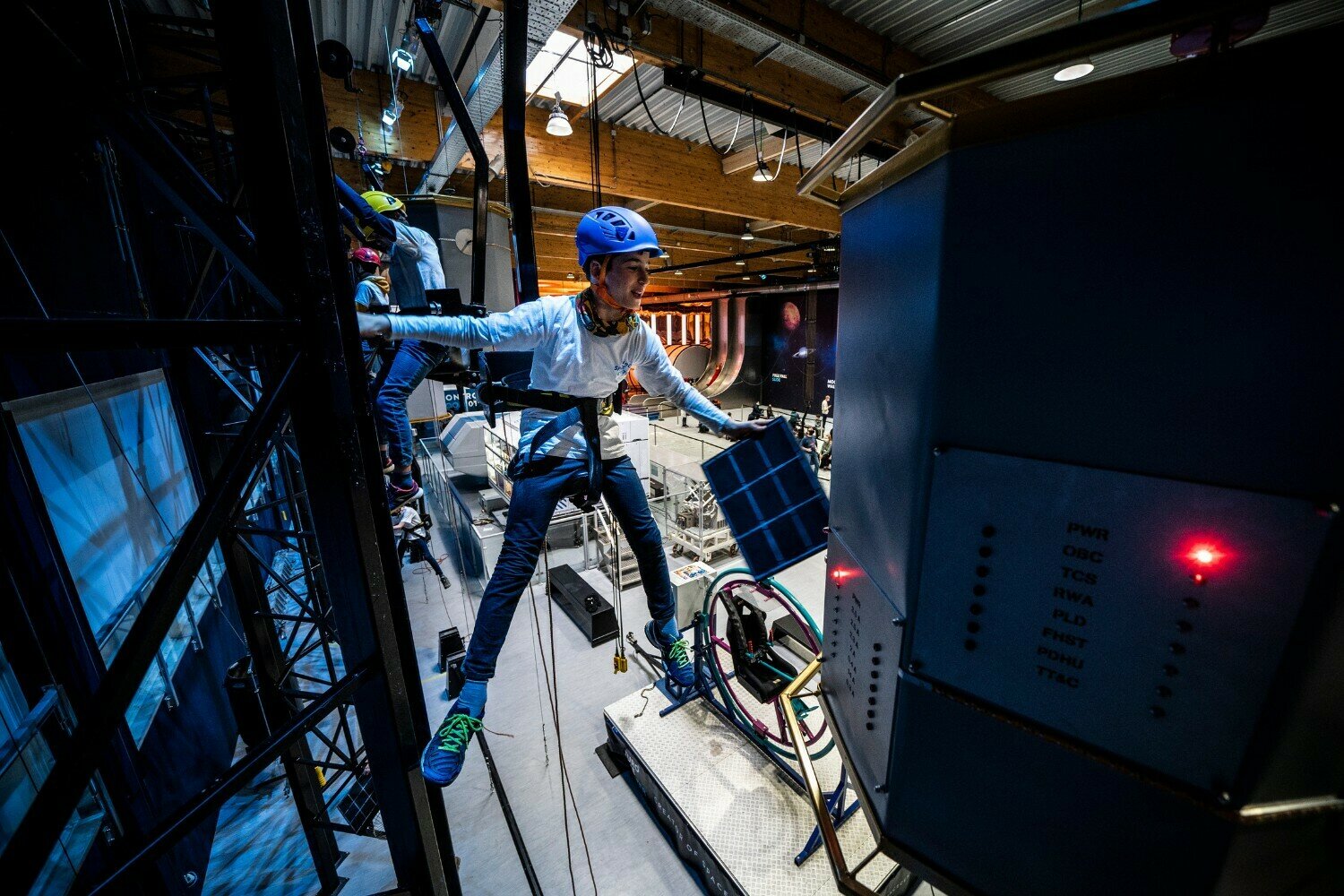
- access to two exclusive activities (Rotating Chair, Multi-Axes Chair or Microgravity Wall);
- a movie night;
- a complimentary Euro Space Center T-shirt;
- full board at the Voyager Café;
- admission to the contemporary art museum Mudia.
Mission Discovery – simulate a real space mission
A more technical experience focused on a complete space mission simulation: launch, orbit insertion, docking with the space station and atmospheric re-entry.
The package also includes:
- building and launching micro-rockets;
- access to three exclusive activities (Rotating Chair, Multi-Axes Chair and Microgravity Wall);
- one night in a space-themed room;
- full board at the Voyager Café;
- a complimentary Euro Space Center T-shirt.
Frequently asked questions — Camps at the Euro Space Center
Which Euro Space Center camp is best for my child?
The best choice mainly depends on your child's age and interests. Astronaut and Astronomy camps cover several aspects of space exploration. Young people interested in technology can choose from subjects such as Robotics, Drones, Telecoms, Satellites or 3D Modelling. Children who enjoy building and experimenting may prefer Rocket or Meteorite camps. The required age varies according to each specialisation.
What age can children attend a camp at the Euro Space Center?
Camps are available for children and teenagers aged 6 to 18, although each theme has its own age range. Junior programmes such as Junior Astronaut and Junior Astronomy are designed for children aged 6 to 8. Other camps generally start from age 9 or older depending on their technical level. Parents should therefore check the age requirement shown for each camp before booking.
What is the difference between a day camp and a residential camp?
Day-camp participants attend activities from Monday to Friday, generally from 9:00 am to 5:30 pm, and return home each evening. With the residential option, the experience begins on Sunday evening and includes accommodation, meals and evening activities through to Friday. Residential camps provide a more immersive group experience and are particularly convenient for families travelling from further away.
What happens during a week-long camp at the Euro Space Center?
A camp includes more than 35 hours of activities from Monday to Friday. Each day combines activities linked to the chosen specialisation, hands-on experiments and breaks. On Friday afternoon, participants present their week to their parents and, depending on the camp, may take part in a rocket launch, robot demonstration or presentation of their creations. The week concludes with a diploma ceremony.
Does my child need previous knowledge of science or technology?
No. No specific previous knowledge is required: activities and explanations are adapted to the participants' ages. Subjects such as Satellites, Telecoms and Robotics are naturally more technical and therefore tend to suit older teenagers. The 3D Modelling camp also offers a level 2 for participants who want to develop skills they have already acquired.
How are accommodation and meals organised during residential camps?
The Euro Space Center has 24 rooms accommodating up to 10 young people each, spread across three floors. Boys and girls are accommodated separately and a night supervisor is present on site. Meals are provided by the Voyager Café and can be adapted to various dietary requirements, including vegetarian, pork-free, gluten-free and lactose-free options.
Are Euro Space Center camps only organised during the summer holidays?
No. The widest selection is available during the summer holidays, but selected camps are also organised during other school holiday periods, including autumn, Christmas, Carnival and spring holidays. Availability depends on the period and the participant's age, and the online calendar can be filtered by date, age and camp theme.
How do you register for a camp at the Euro Space Center?
All camps require advance booking. Registration can be completed through the Euro Space Center website or by contacting the camps team. Available sessions can be filtered online by period, date, age and theme to find the most suitable option. Booking early is recommended because some camp weeks can fill up quickly.