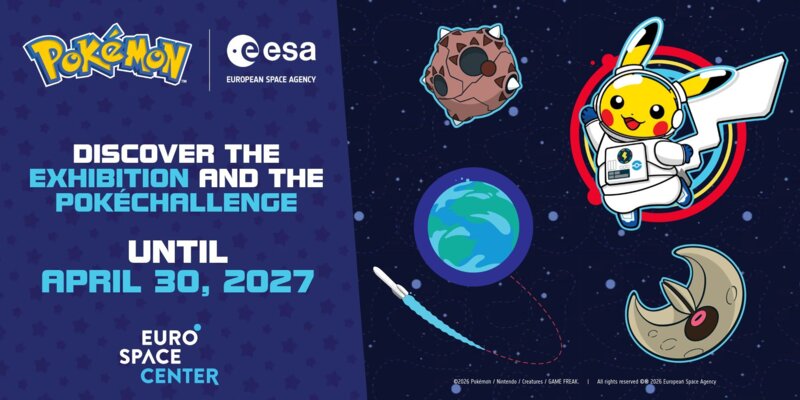
Located in Transinne, in the municipality of Libin, Euro Space Center offers educational school trips focused on space and science, from the final year of preschool through to secondary school. Depending on the students' age and the class's educational objectives, programmes last from 2 to 6.5 hours and combine scientific discoveries, experiments, simulators and workshops.
A school trip is an opportunity to step outside the classroom and explore the subjects studied at school through observation, hands-on activities and practical experiences.
At Euro Space Center, space becomes a learning environment. Why do we walk differently on Earth and the Moon? How does a rocket take off? How do astronauts live in space? Students gradually discover the answers through activities tailored to their age.

Why choose a school trip focused on science and space?
Space exploration offers a practical way to discover many scientific topics: gravity, propulsion, movement, astronomy, living conditions in space and the technologies used to explore the Moon and Mars.
Rather than simply listening to explanations, students can observe, experiment and experience certain scientific phenomena for themselves.
Depending on the chosen package and their age, students can:
- discover the major milestones of space exploration
- experience different gravity conditions with Moon Walk XP or Mars Walk XP
- understand how a rocket works
- build and launch a water rocket or model rocket
- try equipment inspired by astronaut training
- discover the night sky in the Planetarium
- explore what everyday life is like for astronauts.
The aim is not to turn every student into a space expert, but to spark curiosity and make science more tangible through hands-on experiences.

Which school trip should you choose for your students' age group?
Not all programmes are the same. The topics covered, the vocabulary used and the activities offered are adapted to the students' age.
Preschool: discovering space from the age of 5
Young children discover space through simple, practical questions: how do we travel into space? What is a rocket used for? Where do astronauts live? Why would we walk differently on the Moon?
Programmes focus on observation, hands-on activities and age-appropriate experiments.
For children aged 5 to 6, some packages combine a guided visit, a practical workshop and a Planetarium session.
From the age of 6, students can gradually discover experiences such as Moon Walk XP and the junior multi-axis chair. Depending on the chosen package, they can also take part in building and launching a water rocket.

Primary school: learning science through experimentation
From the age of 9, the learning approach becomes progressively more in-depth.
Students discover the Space Tour, the major milestones of space exploration and several technologies used to explore space.
Depending on the chosen programme, they can also try different simulators inspired by astronaut training, such as Moon Walk XP, Mars Walk XP, the rotating chair and the multi-axis chair.
Secondary school: exploring science and space technology in greater depth
Programmes designed for teenagers offer opportunities to develop a deeper understanding of scientific concepts.
Gravity, balance, orientation, space exploration, life aboard a space station and rocket technology can all be explored through experiments and workshops.
Depending on the programme selected, students may explore life in space and scientific experiments, or investigate the principles of propulsion and stability during a workshop dedicated to model rockets.
Which school package should you choose?
The choice mainly depends on three factors: the students' age, the time available and the desired level of immersion.
| Package | Duration | Minimum group size | Age groups / adapted programmes | Type of experience |
| La Visite | 2 hours | 20 students | Ages 5–8 / ages 9+ | Introduction to space and the centre's activities |
| Mission ISS | 3.5 hours | 12 students | Ages 5–6 / ages 6–8 / ages 9+ | Extended visit, experiments and simulators |
| Mission Ariane | 6.5 hours | 12 students | Ages 6–8 / ages 9–12 / ages 13+ | Full day combining space exploration, simulators and workshops |
La Visite: discovering space in 2 hours
La Visite offers a first introduction to the world of space exploration. For children aged 5 to 8, the programme explores topics such as how we travel into space, the International Space Station, Mars and astronaut training.
From the age of 9, the programme includes activities such as the Space Tour, Space Hub, Space Show and an experience involving a centrifuge.
This package is particularly suitable for schools wishing to include an introduction to space as part of a school trip featuring several activities throughout the day.
Mission ISS: 3.5 hours of hands-on experiences
Mission ISS takes the experience further by including more opportunities to experiment.
For younger students, the programme can combine a visit, a workshop and a Planetarium session.
Children aged 6 to 8 can discover activities including Moon Walk XP, the junior multi-axis chair and the Space Tour.
From the age of 9, the programme combines an introduction to space exploration with opportunities to try several training devices, subject to availability.
Mission ISS therefore offers a good balance between scientific discovery and practical experimentation.
Mission Ariane: a full day dedicated to space
With 6.5 hours of activities, Mission Ariane allows students to spend a full day exploring space.
For children aged 6 to 8, the programme can combine Moon Walk XP, the junior multi-axis chair, the Space Tour, the Planetarium and building and launching water rockets.
For students aged 9 to 12, the programme includes activities such as the Space Tour, Moon Walk XP or Mars Walk XP, the rotating chair, the multi-axis chair and a rocket-building and launching workshop.
At secondary school level, the programme allows students to explore scientific and technological phenomena in greater depth, with experiments focusing on life in space or activities involving model rockets, depending on the selected programme.

What can students learn during their school trip?
A school trip to Euro Space Center is about more than discovering objects related to space. The activities provide opportunities to explore several complementary areas of learning.
Understanding scientific phenomena
Gravity, pressure, propulsion and movement become easier to understand when students can observe or experience them directly.
Discovering space technology
Students discover how humans travel into space, move around on the Moon or Mars and organise daily life aboard a space station.
Learning through experimentation
Handling equipment, trying a simulator, building a rocket or observing a phenomenon helps students reinforce the theoretical knowledge covered in class.
Learning together
The activities also encourage discussion, observation and cooperation between students as they complete shared missions or experiments.
One-day school trip or residential school trip?
Every class has different educational objectives. A school trip lasting a few hours or a full day allows teachers to introduce space and science through a one-off educational outing. For a more in-depth experience, Euro Space Center also offers multi-day residential school trips, combining missions, workshops and experiments within a more comprehensive educational programme. These stays will be covered in a dedicated guide to organising a Space Class.
Planning your school trip: practical information
Euro Space Center is located in Transinne, in the municipality of Libin, in Belgium's Luxembourg Province, in the heart of the Belgian Ardennes.
Depending on the chosen package, the school trip lasts 2 hours, 3.5 hours or 6.5 hours. A meal break can be arranged at the Voyager Café or as a picnic, depending on the arrangements made for the group. Programmes may change according to availability and operational requirements. Teachers are therefore advised to check the latest information when planning their visit. Prices and availability can be found directly on the dedicated schools page.

Plan your class's next space mission
From a first introduction to space to a full day of hands-on experiments, every class can choose a package suited to the students' age, available time and educational objectives. Science, space exploration, experimentation and teamwork become the central themes of a learning experience beyond the classroom. Discover our school packages and submit your preliminary booking request.
Organising a school trip to Euro Space Center
Which package should you choose for a primary school class?
The choice depends on the students' age and the time available. La Visite lasts 2 hours, Mission ISS lasts 3.5 hours and Mission Ariane lasts 6.5 hours. The programmes are adapted to different age groups.
Which school trip is suitable for students in the fifth or sixth year of primary school?
Several packages are suitable for this age group. La Visite provides an initial introduction, Mission ISS includes more simulators and Mission Ariane offers a full day dedicated to science and space, including activities involving rockets.
The choice therefore mainly depends on the educational objectives and the preferred duration.
Can students stay overnight and have meals on site during a residential school trip?
Yes. Euro Space Center has 240 beds across 24 rooms, as well as a night supervisor on site during residential school trips.
Meals are served at the Voyager Café. Menus can be adapted to certain dietary preferences or restrictions, including vegetarian, pork-free, gluten-free and lactose-free options.
For full details about accommodation, meals and multi-day activities, consult our guide to residential school trips at Euro Space Center.
Do students need prior knowledge of astronomy?
No. The programmes are designed to introduce students gradually to the subjects covered. Explanations are adapted to their age and educational level.
Are the activities supervised?
Yes. Guided activities are supervised by Space Instructors, who introduce the experiences, provide instructions and adapt their explanations to each group.
Where can I find prices and book a school trip?
Prices, availability and all the information needed to prepare your school trip are available on the Euro Space Center schools page.
You can also submit a preliminary booking request there.