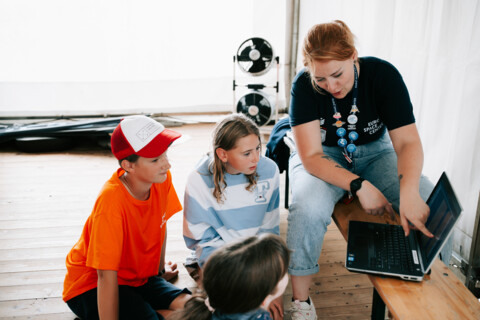
A secondary school trip at a glance
Which programme should you choose for a secondary school class?
The best option depends on the time available, the students' ages and your educational objectives. Here are the four possibilities available to school groups.
| Programme | Duration | Minimum group | Best suited for |
|---|---|---|---|
| Day visit | 2 hours | 12 students | Discovering the world of space |
| Mission ISS | 3 hrs 30 min | 12 students | Combining discovery and simulators |
| Mission Ariane | 6 hrs 30 min of activities | 12 students | Spending a full day exploring science |
| Space Classes | 2, 3 or 5 days | 16 participants | Building a multi-day educational project |
Day visit: discover space in two hours
The day visit includes the Space Tour, Space Hub, Space Show and one of the flagship experiences, the Space Rotor. Students discover space exploration and test some of the abilities associated with astronaut training.
This programme is particularly suitable when the time available on site is limited.
Discover the Day Visit programmeMission ISS: discover and experiment
Over 3 hours 30 minutes, Mission ISS combines an introduction to space, the Space Tour and two hours using two astronaut training simulators, subject to availability: Moon Walk XP, the multi-axis chair and/or the rotating chair.
The experience becomes a starting point for exploring gravity, balance and orientation.
Discover the Mission ISS programmeMission Ariane: a full day of science
Mission Ariane offers 6 hours 30 minutes of activities during a full day that also includes breaks.
The secondary school programme combines the Space Tour, Moon Walk / Mars Walk XP, the rotating chair and the multi-axis chair. It then continues with either a module on life in space and scientific experiments or a workshop involving the construction and launch of micro-rockets.
The programme must be confirmed according to the students' ages, particularly for classes including 12- and 13-year-olds.
Discover the Mission Ariane programmeSpace Classes: extend the learning experience
For a multi-day school trip, Space Classes combine missions, simulators and workshops. Depending on the length and programme chosen, students can explore programming and satellite technologies or take part in a team-based space mission simulation.
Accommodation, meals, activities and supervision are all provided on site. The Euro Space Center offers 240 beds, while the Voyager Café can accommodate up to 218 people.
Full programme – Full-timeHow can the school trip be used in science lessons?
A school trip can become a fully integrated part of an educational project. The STEM approach — science, technology, engineering and mathematics — becomes especially meaningful when students connect their observations to a question, hypothesis or problem to solve.
Gravity, weight and movement
Moon Walk XP and Mars Walk XP make it possible to explore movement under different gravity conditions. Teachers can use the experience to help students distinguish between mass and weight.
Propulsion and stability
When a rocket workshop is included, students can form hypotheses about propulsion, the role of fins or the recovery system, and then compare their ideas with what they observe during the activity.
Vacuum and pressure
Experiments involving a vacuum can be used to investigate the propagation of sound, the behaviour of gases or the boiling of liquids. Back in the classroom, students can further distinguish between observation and interpretation.
More than 35 years of experience welcoming school groups
For more than 35 years, the Euro Space Center has welcomed school groups for educational experiences focused on science and space exploration. For residential stays, activities, accommodation, meals and supervision are all provided on one site, making organisation easier for teachers and accompanying adults.
How should you prepare your school trip or residential stay?
Start by defining two or three objectives: illustrate a topic covered in class, develop an experimental approach, strengthen teamwork or build a STEM project. Then provide the students' school year, ages, group size and the time available.
Before booking transport, have the programme, timetable, activity access requirements and supervision arrangements confirmed. Please also inform us of any dietary requirements or specific needs among participants.